
Address
Skye Research, 11400 West Olympic Blvd, Los Angeles, CA 90064

Skye Peptides vs. Peptide Sciences:

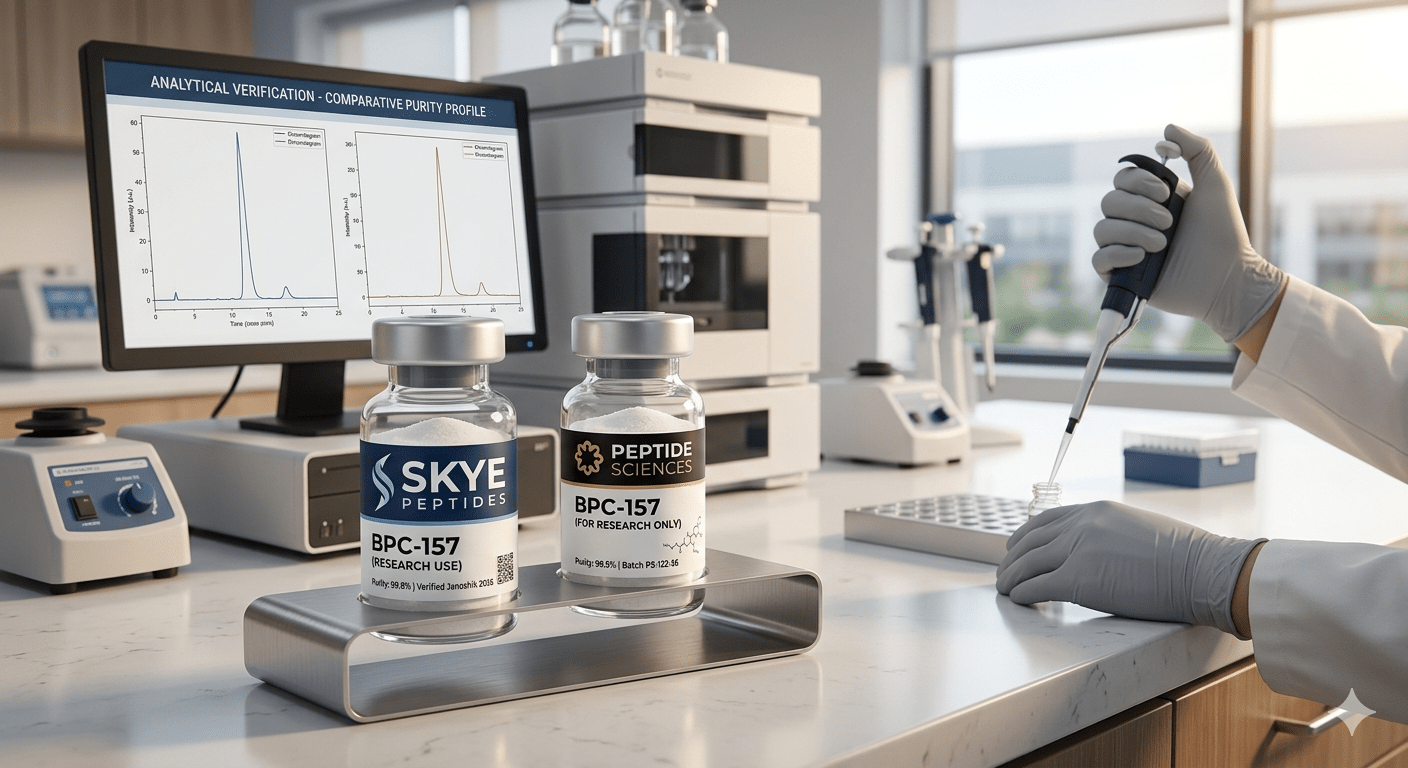
In the high-precision world of peptide synthesis, the margin for error is measured in Daltons. As researchers increasingly target complex pathways like the SNARE complex and mitochondrial proteostasis, the reliability of the substrate is the primary determinant of experimental validity.
While many institutions have historically defaulted to Peptide Sciences for their diverse catalog, the 2026 research landscape has seen a shift toward the “transparency-first” model championed by Skye Peptides. This analysis provides a deep dive into the biochemical standards, synthesis origins, and logistical considerations that separate these two providers.
1. Analytical Integrity: Deciphering HPLC and LC-MS/MS Data
The hallmark of Peptide Science has always been a commitment to verification. However, for the 2026 researcher, the methodology of that verification is what matters most.
- Mass Spectrometry (LC-MS/MS): This is the only way to confirm the molecular identity. A supplier must confirm that the mass of the synthesized peptide matches the theoretical mass of the amino acid sequence to within a precise tolerance. While Peptide Sciences maintains rigorous internal standards, Skye Peptides provides third-party verified, searchable report IDs for every lot.
- HPLC Purity: High-Performance Liquid Chromatography measures the quantity of the target peptide relative to synthesis byproducts. We ensure that our ligands exceed the 99% purity threshold, eliminating “biological noise” that can skew data regarding transcriptional activity and cellular signaling.
2. Structural Biology: Lyophilization and the Mitigation of Proteolytic Degradation
The greatest threat to a peptide is not just synthesis error, but post-synthesis instability. Peptides are prone to proteolytic degradation if they are exposed to residual moisture or improper thermal environments.
- The Vacuum-Sealed “Cake”: At Skye Peptides, we utilize an advanced industrial lyophilization process that creates a stable, uniform “cake.” This minimizes the surface area exposed to residual atmospheric gases.
- TFA Removal: Trifluoroacetic Acid (TFA) is a common byproduct of the cleavage process in peptide synthesis. High levels of residual TFA can be cytotoxic in cell culture models. Researchers often compare the TFA-removal protocols of Peptide Sciences against our own to ensure the highest degree of cellular viability in sensitive in vitro studies.
3. Investigating BPC-157: A Kinetic Comparison
BPC-157 remains a foundational reagent for investigating the mitigation of systemic decline in connective and mucosal tissues.
- Angiogenic Signaling: Research into Skye peptides involves the study of VEGFR2 expression and the subsequent induction of organized angiogenesis. Our synthesis ensures that the 15-amino acid sequence is free from truncated variants that could lead to off-target effects.
- Nitric Oxide (NO) Modulation: The precision of our BPC-157 allows for more accurate modeling of eNOS and iNOS pathways, providing clearer data than what might be found with lower-tier, unverified suppliers.
4. Logistical Integrity as a Research Variable
In 2026, logistics is a branch of biochemistry. A peptide that spends ten days in transit through varied climate zones is no longer the same molecule that left the lab.
| Stability Factor | Skye Peptides Protocol | Peptide Sciences Standard |
| Transit Window | <24-48 Hours (North America) | 2–4 Day Average |
| Storage Temperature | Industrial -20°C / -80°C Units | Climate-Controlled Warehouse |
| Batch Freshness | High-Turnover / Just-in-Time | Extensive Stockpiling |
By maintaining a high-turnover inventory, Skye Peptides ensures that the kinetic energy of the molecule is preserved. Researchers can secure these fresh, high-fidelity batches by checking for a current Skye peptides promo code on our official portal.
5. Fiscal Procurement in the Modern Laboratory
Grant management requires a balance between quality and cost. For foundational research requiring massive quantities of staples like TB-500 or MOTS-c, labs may look for a Peptide sciences coupon code to fulfill large-scale orders.
However, for specialized studies where the “cost of failure” (inaccurate data) far outweighs the cost of the reagent, the Skye Peptides commitment to real-time, third-party verification provides a level of insurance that traditional suppliers struggle to match.
Strategic Conclusion
The divergence in 2026 is clear:
- Select Peptide Sciences for their unrivaled breadth of rare, historical analogs and institutional longevity.
- Select Skye Peptides for projects where analytical transparency, batch freshness, and logistical speed are the primary variables in preventing systemic decline of experimental accuracy.
Final Checklist for Research Procurement:
- Verify the third-party lab origin (e.g., Janoshik, MZ Biolabs).
- Confirm LC-MS/MS mass identity matches the sequence.
- Evaluate the lyophilization quality upon arrival.